
For a brand, opening a YouTube channel can seem like the natural next step in a content strategy. The decision is less obvious than it looks.
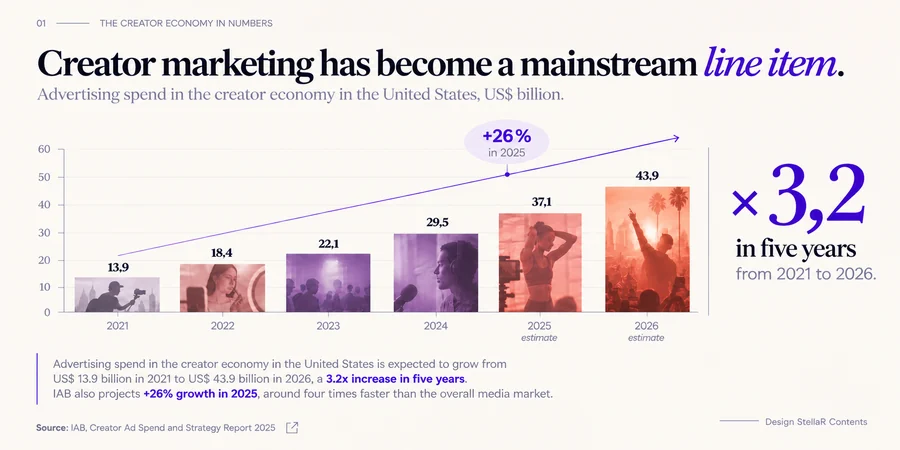
In the United States, YouTube represented 14.2% of all television viewing in July 2026, ahead of every major media group measured individually by Nielsen. Meanwhile, U.S. creator advertising spend is projected to reach $44 billion in 2026, up from $29.5 billion two years earlier, according to IAB.
YouTube is no longer simply a social platform on which brands publish content. It is a media environment, a recommendation engine, a content library, and a growing infrastructure for creator marketing.
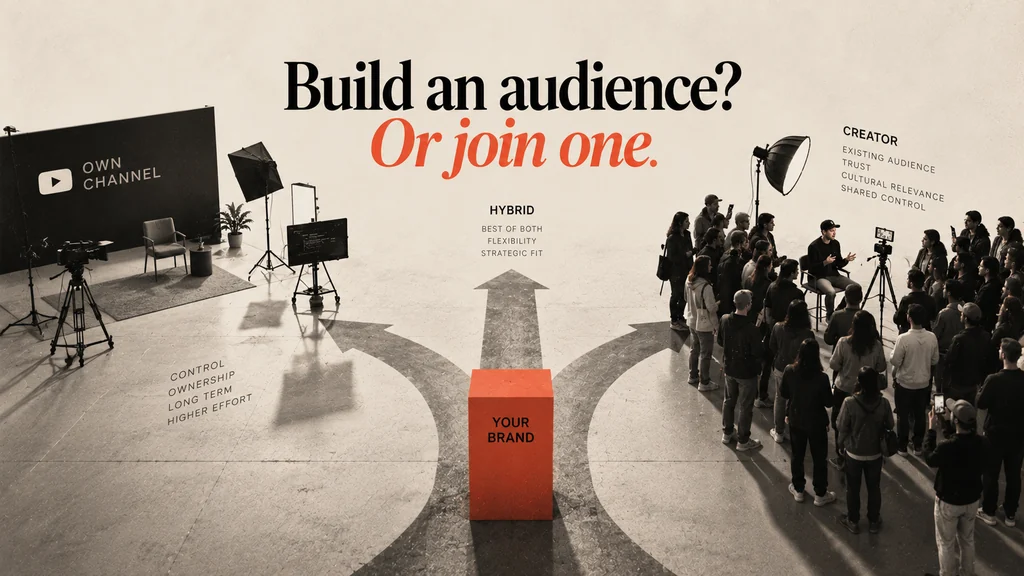
The question is no longer simply: should we make our own videos or work with a creator?
It is whether to bear the cost and risk of building an editorial asset and an audience, or gain access to what a creator has already built.
Do you actually have something to publish?
A YouTube channel needs an editorial promise, not a stockpile of commercial videos.
Expertise that is hard to find elsewhere. Privileged access to a world. Characters. A point of view. Recognisable formats. Enough substance to give someone a reason to return independently of the marketing calendar.
A simple first stress test is to write six video ideas that have nothing to do with a product launch. If they are difficult to find, distribution is probably not yet the problem. The problem is editorial.
Having a story, products, or expertise does not automatically give a brand a strong editorial proposition. Those are raw materials. The challenge is to understand why an audience would choose to watch. That is the first important distinction.
A brand can have plenty to say without yet having something people would choose to watch.
Brands can succeed. But creators dominate the playing field.
There is no sufficiently robust statistic to claim that 4% or 16% of brand channels fail.
It would be a dubious measure in any case. What would success mean: a million subscribers, sales, an established area of expertise, or a catalogue people still use five years later? There are, however, useful indicators of where attention is concentrated.
In its 2025 Food & Beverage study, Pixability reports that more than 99% of the 4,000 leading channels studied were creator channels, rather than brand or publisher channels. In travel, creators represented more than 95% of the leading channels studied.
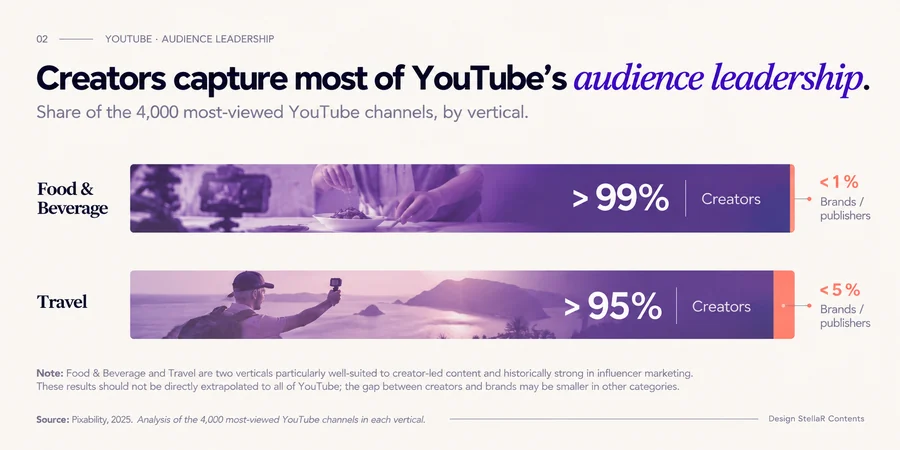
These are two specific verticals, measured by a commercial player in the YouTube ecosystem. They are not a universal failure rate.
They do, however, point to something important: when the competition is for organic attention, brands that can consistently compete with creators are a minority.
That is hardly surprising. Brands traditionally organise their content around their own priorities: launches, products, campaigns, messages, and calendars.
Creators organise theirs around another constraint: will someone click, and then keep watching? On YouTube, that organisational difference can become a competitive advantage.
The algorithm does not appear to favour creators. Viewers often do.
It would be tempting to explain creators' lead by pointing to the algorithm. That is not what YouTube documents.
The platform says its system seeks to show each viewer videos they are likely to want to watch and to maximise satisfaction over time. It groups signals around three broad dimensions: appeal, engagement, and satisfaction.
YouTube also notes that its system identifying a video as an ad, brand content, or creator content is not, in itself, what determines its recommendation.
There is therefore no documented reason to assume that a video is distributed less simply because a brand published it. But the two players do not start with the same advantages.
An established creator generally has three assets already: an audience, an editorial language, and a relationship of trust.
A brand may have something else: expertise, access, products, data, perhaps intellectual property and greater resources.
The algorithm does not turn a brand into a handicap. The difficulty is that viewers compare its content with everything else on YouTube.
That is the essential distinction.
Building a channel also means building distribution
Owning a channel gives a company control over its editorial direction, formats, catalogue, and some of its rights. It does not give the company an audience.
YouTube remains third-party infrastructure whose system continually decides which content to show to which users.
A brand channel is therefore less an owned audience than an owned editorial asset distributed on a platform the brand does not control.
That nuance changes the investment required.
A brand pursuing this route must fund more than production. It has to learn which topics really interest its public, which formats work, which thumbnails earn a click, where attention drops off, and why one video is recommended more than another. It is building more than content.
It is building media capability.
That takes time.
When it works, a channel creates more than one-off reach
This is where the model becomes interesting.
Unlike many digital campaigns whose effects end when the budget runs out, YouTube content can keep generating an audience after publication.
Google reports that, on average, more than 60% of organic watch time among the top 1,000 brand channels came from videos more than 30 days old. The economics begin to resemble a stock more than a stream.
Each video can continue to be searched for, recommended, shared, added to a playlist, or rediscovered months later.
What started as a production cost can gradually create multiple assets: a catalogue, a better understanding of the audience, formats, intellectual property, and sometimes a recurring editorial relationship.
Mattel's cases are older but instructive. Tubular Labs reported that a 36% rise in Barbie's YouTube views coincided with a 14% rise in sales, while Hot Wheels recorded a 66% increase in views and 7% sales growth. These numbers do not show that YouTube alone caused the sales. They illustrate how Mattel treated video audiences as a strategic asset around its franchises. The right measure is probably not subscriber count alone. It may look more like this:
Value created = catalogue + reachable audience + intellectual property + authority + learning + commercial impact.
A creator partnership buys what might take years to build
The alternative is to begin with someone else's asset.
Instead of building its own distribution, the brand gains access to an existing one.
IAB estimated U.S. creator advertising spend at $37 billion in 2025, after 26% annual growth. Of the advertisers surveyed, 48% now described creators as a “must buy,” behind only paid search and social.
YouTube says its partnerships programme gives brands access to more than three million creators. But the brand is buying more than reach. It is buying context.
The creator knows how to present a topic, where it belongs within their work, what tone to use, and how far to push a commercial argument without breaking the relationship with their audience. That mediation is precisely where the value lies.
It also has a limit: the relationship primarily belongs to the creator.
A campaign can drive awareness, consideration, or sales without the brand having built a media property of its own.
A YouTube partnership is not necessarily a short-term asset
That is another assumption worth challenging. YouTube behaves more like a library than an ephemeral feed.
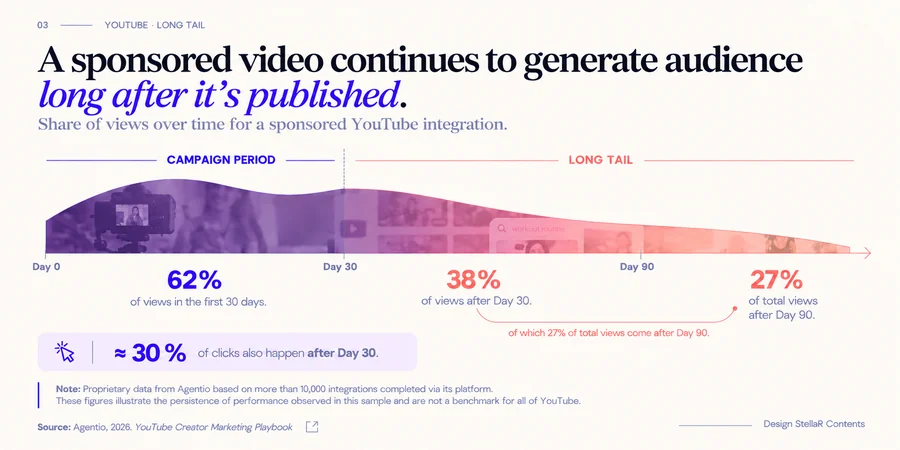
Google reports that long-form sponsored videos retain, on average, more than 65% of their launch-month watch time in month two, while 30% of clicks can arrive more than 30 days after publication. Agentio's proprietary data points in the same direction.
These figures come from companies selling exactly this kind of campaign and should be read accordingly. But they support an important strategic point: owned channel equals long term, creator equals one-off campaign is too simple.
A strong creator partnership can also create a lasting asset.
The distinction is who owns the media property and who owns the relationship.
B2C and B2B: the same question, different economics
This is perhaps where the distinction matters most. In B2C, the challenge is often attention at scale.
A food, automotive, beauty, or fashion brand may need to reach millions of potential customers. An owned channel is rarely a simple substitute for the distribution power of creators who regularly make entertainment, expertise, or culture.
Creators offer something hard to recreate: a large audience that has already chosen to listen. In B2B, the calculation changes.
Raw audience size matters less when a few thousand people represent a meaningful share of potential commercial value.
Google notes that 92% of B2B buyers had already formed a supplier shortlist before they meaningfully began the purchase process. Edelman and LinkedIn found that nearly three in four professionals regard thought leadership as a more credible way to assess an organisation's capabilities than traditional marketing materials.
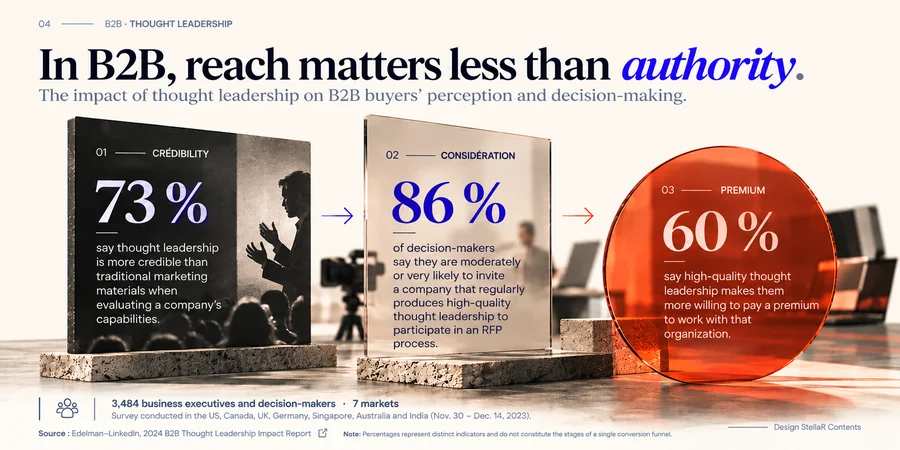
Content therefore has a role much earlier in the decision.
It may come from a leader, an expert, a customer, a partner, or a specialist creator.
The right model may be brand-owned, people-led: the company owns the editorial strategy and infrastructure, while individuals carry the relationship.
In B2C, the decision often turns on whether a brand can capture enough attention.
In B2B, it turns more on whether expertise can become authority.
What is the opportunity cost: what does failure really cost?
This is essential and difficult to quantify properly.
There is no serious benchmark establishing that a failed YouTube channel costs, on average, a particular six-figure sum.
The configurations vary too widely: volume, production level, internal teams, agencies, talent, rights, location, paid media. But the economics of risk are fairly clear.
A channel turns a substantial share of spend into fixed costs: strategy, team, production, management, learning, and infrastructure are committed before anyone knows whether an audience will emerge.
A creator partnership turns more of it into variable costs: each collaboration can be tested, measured, learned from, and adjusted.
A channel's failure also creates three less visible losses: capital spent, organisational time, and opportunity cost. There is a paradox, though.
Waiting for a perfectly proven strategy before publishing prevents you from accumulating the evidence needed to build one.
The right way to limit risk is probably not to wait until you have the answer.
It is to lower the cost of proof.
Three models, three different assets
Once these pieces are in place, the decision becomes easier to read.
A brand channel lets you build a catalogue, formats, intellectual property, and a deeper understanding of the audience over time. In return, it demands time, expertise, and acceptance of a risk: producing before you know whether anyone will watch.
A creator partnership partially reverses that equation. Distribution and trust already exist. But the brand gains access to that relationship more than ownership of it.
Between the two, the hybrid model deserves more attention than it often gets. It does not simply mean “do a bit of both.”
It means deciding exactly what the brand owns, what the creator owns, where the content lives, who controls the format, which rights can be reused, and how audiences might gradually move between the assets.
YouTube itself is increasingly pushing in that direction through its brand and creator collaboration tools.
The line between media, the creator economy, and advertising continues to blur.
| Option | What the brand builds or buys | Main advantage | Main risk |
|---|---|---|---|
| Brand channel | Catalogue, formats, IP, editorial capability | A compounding asset | Funding a media operation that never finds its audience |
| Creator partnerships | Distribution, context, trust | Immediate access to an existing audience | The relationship stays primarily with the creator |
| Hybrid model | Owned IP plus external voices and distribution | Combines building with access | Coordination, rights and unclear responsibilities |
Start with a hypothesis, not a channel
Before committing to an annual programme, the question should be framed differently.
Not: “How many videos are we going to make?”
But: “Which hypothesis do we want to test?”
A B2C brand can test whether it really has strong enough editorial material to generate repeat viewing.
A B2B company can see whether an internal expert earns more attention and trust than the institutional voice.
Another can start with a few creators, find out which topics actually generate interest, and then turn the strongest into proprietary formats. The measures must follow the intention.
A channel designed to establish expertise should not be judged on views alone.
A programme built to acquire customers should not be judged on engagement alone.
And a programme intended to build a media property should probably not be evaluated after three videos.
Choose the asset, not the channel
An owned channel makes sense when a brand has distinctive editorial material, is willing to fund the learning process, and wants to build an asset it controls more fully over time.
Creators become particularly valuable when a community and a credible voice already exist around the subject the brand wants to explore.
A hybrid makes sense when a company wants to retain part of the IP while working with the talent and networks that already attracted the audience.
The choice depends less on video format than on what the company is really trying to accumulate: catalogue, distribution, trust, authority, intellectual property, or a relationship with its audience.
A brand can become a media company.
It should not assume that this is the right choice by default.
Three questions often clarify the decision before launching a channel. Which asset do we still want to own in three years?
Do we really have a reason to be watched, or only a reason to communicate?
And are we better placed to build this relationship or to partner with someone who already has it?
The question is no longer really “should we launch our own YouTube channel?”
It becomes:
Sources & references
- Nielsen — The Gauge, July 2026
- IAB — Creator Economy Ad Spend & Strategy Report
- Pixability — 2025 Food & Beverage Study
- Pixability — 2025 Travel Study
- YouTube — Recommendation system and content performance
- Google — Top-performing YouTube genres and ads
- Google — YouTube ROI: creator marketing that compounds
- Agentio — 2026 YouTube Creator Marketing Playbook
- Google — B2B marketing strategies
- Edelman–LinkedIn — 2024 B2B Thought Leadership Impact Report
- YouTube — Creator Partnerships
- YouTube — Dynamic brand segments pilot
- Tubular Labs — Mattel case study