
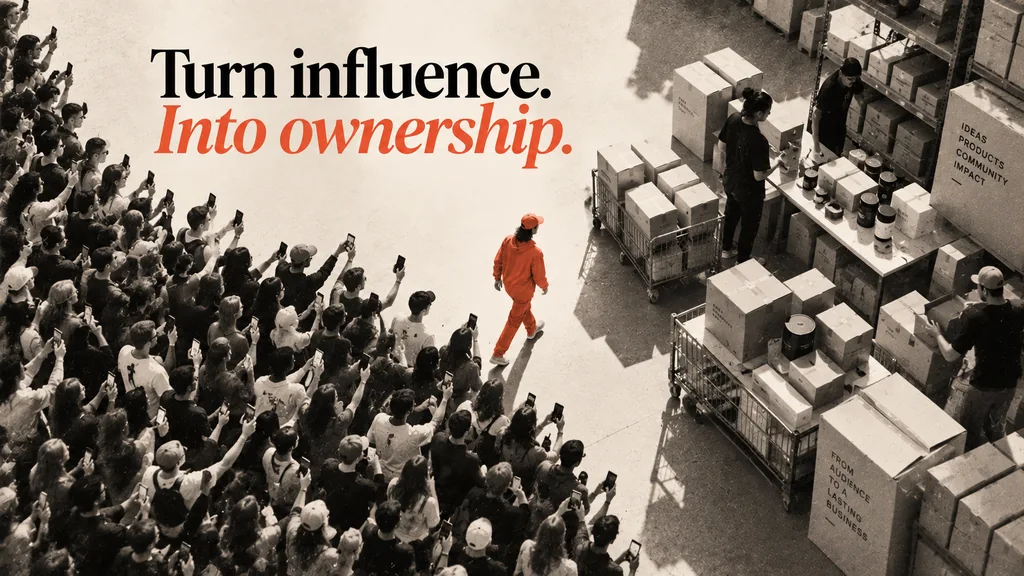
From influence to ownership
An audience can give a launch a head start. It is not enough to build a business. A talent-led brand needs to turn attention into demand, then turn that demand into an experience compelling enough to bring customers back.
This is the shift I explore in my white paper on talent-led brands: moving from monetising influence through individual deals to building lasting business value. The talent becomes more than a promotional partner, contributing to the vision, the product and the brand itself.
Coherence is the first asset
A talent-led brand draws its identity and proposition from a personality’s creativity, expertise or influence. It may be built around a creator, an artist or an athlete. Its strength is not just the size of that person’s following, but the credibility of the connection between the talent, the product and the need it addresses.
Before choosing a category, ask a simple question: why is this person credible in offering this product? First-hand knowledge of a use case, recognised expertise or a distinctive vision provides a stronger answer than a commercial opportunity alone.
Then imagine removing the talent’s name from the packaging. What remains? Quality, usefulness, positioning, an experience? Recognition may prompt the first purchase. The product needs to provide a reason for the next one.
Content can support the product without becoming a catalogue
The white paper highlights the relationship between content and product. Demonstrating a use, sharing a development milestone or listening to community feedback can strengthen both the offer and the relationship with the audience.
That continuity requires balance. If every appearance becomes a sales pitch, the relationship risks losing its substance. Content needs to retain value of its own: informing, entertaining, teaching or bringing people together. The product can then occupy a meaningful place in a world the audience already chooses to follow.
The community can also be a source of learning. Its reactions may help refine a proposition or improve a prototype. They do not replace evidence of demand: expressed enthusiasm and willingness to buy are different signals.
Behind the brand, a business to organise
Building a brand brings responsibilities that content production alone does not cover: product development, quality, sourcing, logistics, customer service and financial management. The talent cannot simultaneously be the creative engine, the distributor and the answer to every operational problem.
Teams and partners therefore need attention from the start. Who owns the product? Who runs operations? Who monitors costs, inventory and cash requirements? Clear responsibilities allow the talent to contribute where they add the most value.
The model also needs to work beyond launch. Examine what a sale leaves after production, distribution, delivery and service costs, then what is needed to generate the next one. Visibility does not remove the need for this discipline.
Build a relationship beyond platforms
Access to a community on a platform is a starting point, but remains dependent on that platform’s rules and audience habits. Building a customer relationship through purchases, service and communications people choose to receive gives a brand other ways to learn and earn loyalty.
Direct sales and distribution partners serve different needs. The former brings a brand closer to the customer experience; the latter can broaden product access. The right approach depends on the category, how people buy and operational capacity. It should develop progressively rather than multiplying channels from day one.
Four questions before launch
The white paper’s roadmap starts with feasibility. I would summarise it through four questions:
- What specific need will we serve? Define an audience, a use case and a meaningful difference.
- Why is the talent credible? Connect the product to relevant expertise, experience or vision.
- Who can deliver the promise? Bring together product, operations, distribution and management skills.
- What must we learn before scaling? Test demand, the customer experience and the economics.
The goal: a brand that earns its own place
A lasting talent-led brand retains a strong connection to its founder while building its own reasons to be chosen. That requires a clear promise, reliable products, an organisation that delivers and a relationship sustained by more than launch announcements.
Turning influence into a business means converting an initial advantage into a system that works over time. The challenge is not simply to launch successfully. It is to prepare for what comes next.