

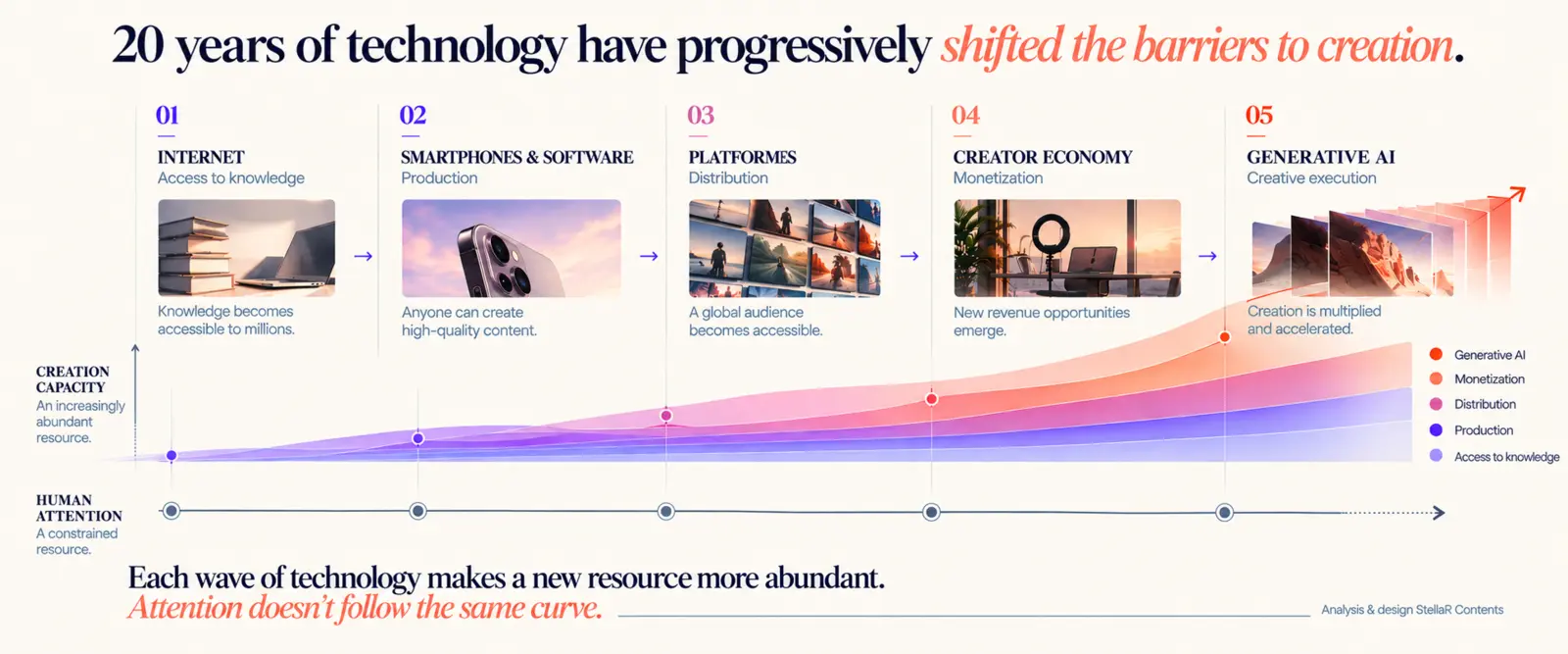
Over the past twenty years, technology has progressively lowered the barriers that used to protect content production.
The internet opened access to knowledge. Smartphones and consumer software democratized production. Platforms opened distribution. Social networks made it easier to reach audiences directly. The creator economy multiplied monetization options.
Artificial intelligence takes that progression a step further: it reduces some of the time, cost and skill required to turn an idea into content.
Abundance did not begin with AI
More than 20 million videos are uploaded to YouTube every day, according to the platform's September 2026 announcement.
That scale is difficult to grasp because it is no longer the scale on which the traditional audiovisual industries were built.
Doug Shapiro, former Chief Strategy Officer at Turner and a media industry analyst, offered a useful comparison in 2023. Based on data available for 2022, he estimated that roughly 15,000 hours of new original films and television programs were produced in the United States annually. At the time, YouTube reported receiving roughly 500 hours of new video every minute, or more than 250 million hours per year.
The YouTube figure expressed in hours is now dated, and the rise of Shorts makes extrapolating from it unreliable. The comparison still makes one point clear: the system has changed in kind.
In France, the CNC recorded 4,157 hours of publicly supported audiovisual programming in 2025, alongside 290 approved feature films. The French and US measures cover different things and cannot be compared directly. Together, they suggest that organized audiovisual production in a major national market is measured in thousands or tens of thousands of hours a year.
A global platform, meanwhile, receives more than twenty million new videos a day.
The more interesting difference, however, is not quantitative. It is economic.
Traditional production has historically relied on selection before production: relatively few projects make it through development, funding, production and distribution.
Platforms have largely inverted that logic. Vast amounts of content can be made and published before the market, viewers, recommendations, search and communities, determines what deserves to be watched.
We have moved from an economy where scarcity limited what could be produced to one where abundance delegates more selection to what happens after publication.
AI is accelerating the shift. It is not just democratizing tools; it is gradually lowering the cost of execution itself: writing, illustrating, editing, dubbing, translating, animating and adapting.
In December 2025, an average of more than one million channels used YouTube's AI creation tools daily, according to the platform. In the same letter, YouTube said it was strengthening its systems against repetitive, low-quality AI content.
These two statements tell the same story: as production capacity grows, the ability to select what deserves attention becomes more important.
Technology has also changed what we mean by quality
If more content can achieve a level of finish once reserved for expensive productions, we first need to define quality.
For a long time, much of it was visible in the resources invested: image, sound, sets, casting, effects, direction and distribution. These attributes still matter, particularly in some categories. But the last twenty years have shown that they are insufficient to explain preference.
YouTube, Twitch, TikTok and podcasts have produced technically simpler work that can compete with far more expensive productions. It has not done so by imitating television more convincingly, but by meeting different needs: relevance, proximity, expertise, perceived authenticity, personality, participation, community and immediacy.
In other words, production value and consumption value have gradually come apart.
A video shot in a bedroom can have low production value and enormous value to its audience. Conversely, a technically flawless production may give people no compelling reason to choose it.
This matters to the impact of AI. Generative tools raise the level of polish available at low cost just as polish alone becomes less differentiating.
The technical floor is rising. Preference does not rise automatically with it.
A spectacular image, a perfectly synthesized voice or a sophisticated animation may gradually become commodities. The value gap moves elsewhere: what is being told; who tells it; what they know or own; how the audience interprets its origin; and the relationship already built with them.
Abundance therefore does not necessarily mean a uniform increase in “quality”. Not all content serves the same need.
Low-quality content can perform extraordinarily well
The rise of AI slop - low-quality digital content produced at scale with generative AI - makes the point visible.
Some low-cost AI content is not designed to build a work, an expertise or a lasting relationship. It is designed to generate enough signals to enter recommendation loops and capture the advertising dollars that follow.
In late 2025, AI Forensics studied 354 automated TikTok accounts across 20 languages. In one month, they published more than 43,000 posts, mostly AI-generated, and amassed 4.5 billion views. The researchers describe a volume-led strategy for testing and optimizing recommendation systems quickly.
The phenomenon extends beyond social platforms. In March 2026, DoubleVerify's Fraud Lab identified a coordinated network of more than 200 made-for-advertising sites publishing the same AI-generated articles and images. DoubleVerify said the network had already generated tens of millions of ad impressions funded by advertisers.
These cases do not measure slop's total share of content consumption. They do show something important: content need not meet the cultural or advertising industry's standards of quality to capture attention and economic value.
When marginal cost falls far enough, the economics change. A producer no longer needs every item to work. They can publish at scale, observe what finds distribution, discard the rest and quickly multiply variants of what performs.
This looks less like a studio and more like a portfolio of options: many can fail; a few need to succeed. Volume itself becomes a risk-reduction mechanism.
The slop economy challenges a comfortable assumption: more content does not necessarily lead to the natural selection of the “best” work. The attention market may reward repetitive, derivative or weak content by traditional editorial standards if it performs the function for which it was optimized.
That changes the question we ask of quality: if content the industry considers poor holds the attention of millions, is it truly low quality, or are we measuring something else?
Supply is democratizing faster than attention
Here is the economic paradox. The cost of entry into creation falls. The number of producers rises. Available supply explodes. But one resource remains remarkably stable: human time.
Technology has democratized creation far more quickly than it has democratized access to attention. Even when consumers stack multiple activities, the capacity to give something genuine attention does not grow at the same rate.
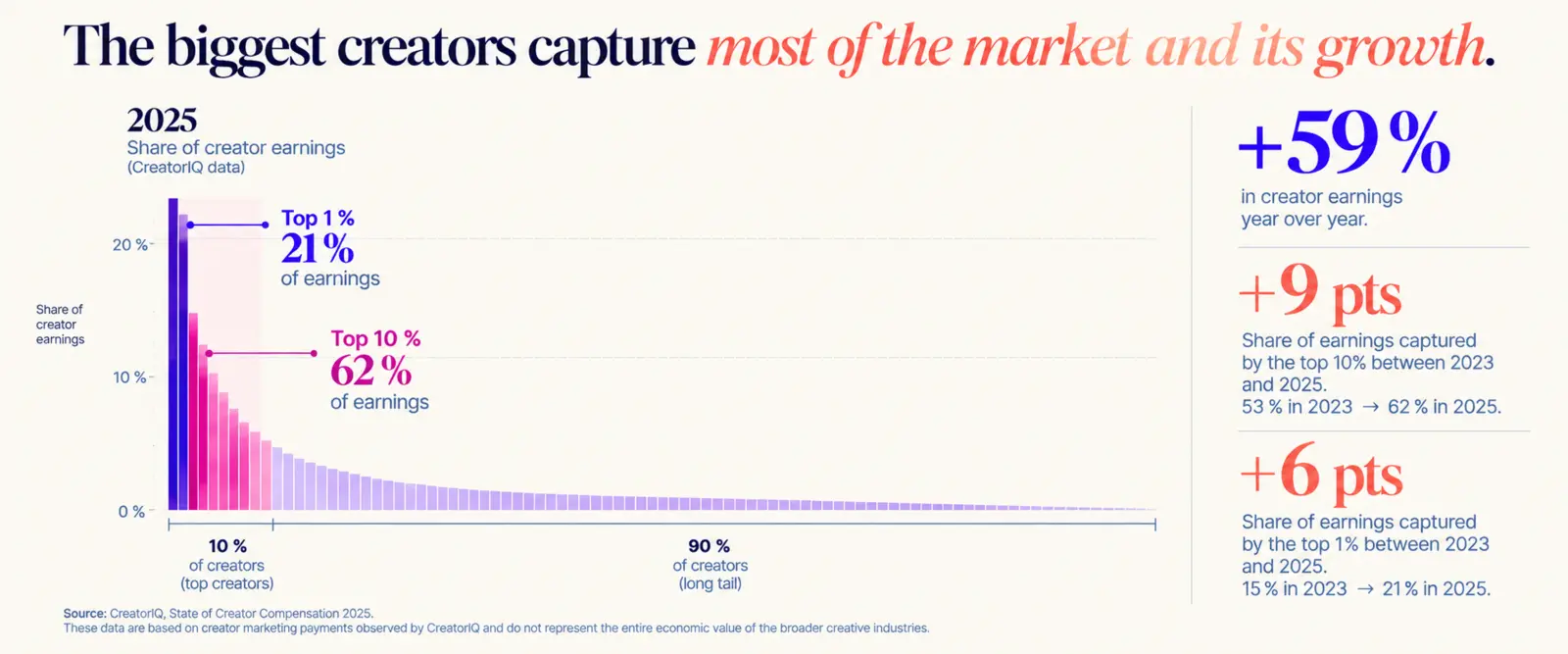
More content does not mean that every producer receives a proportional share of the value created. Cultural industries remain highly asymmetric: abundant supply, relatively few hits, and attention concentrated on a minority of assets, talent and IP.
Abundance does not eliminate scarcity. It moves it.
As explored in An audience is not (yet) a meaningful relationship, a piece of content's performance is different from the relationship its brand actually accumulates with viewers. A platform tries to identify what a user will want to watch next; a brand tries to become one they will want to return to.
As alternatives multiply, having to win back attention from scratch with every publication becomes expensive. An audience that already knows why it wants to return becomes a more valuable asset.
Abundance makes uncertainty the central problem
This shift affects the entire value chain. Audiences do not always know where to spend their time. Platforms cannot know in advance which content will satisfy each person. Advertisers cannot always know the context in which their investment will appear. Producers cannot know which idea will find an audience. Distributors cannot know which title deserves more exposure. Investors cannot know which creative asset will retain its value.
Abundance does not remove risk. It may increase some of it. And when a market becomes more uncertain, anything that reduces uncertainty gains value.
That is one reason IP remains central while production capabilities become more widely available.
In its review of entertainment and media deals in the first half of 2026, PwC explicitly identifies content IP as a premium asset. Franchisable worlds and catalogs with cross-platform potential attract the highest multiples, while proprietary data and distribution capabilities also support valuations.
This is not at odds with falling production costs. It is almost their mirror image: when producing gets cheaper, owning something worth producing becomes more important.
A known franchise, an archive, a talent, proprietary data, recognizable expertise, a character, a format, a community or privileged access does not guarantee success. But it removes part of the unknown. It gives a starting point, recognition, history, context and some reason to believe a new work can find its place.
IP is therefore both a source of differentiation and a tool for reducing risk. Sequels, prequels and franchises are the most visible illustrations.
The same search for certainty produces opposite responses
Premium entertainment and the slop economy may appear to have little in common. One may commit hundreds of millions to a few productions; the other may produce thousands of variants at negligible marginal cost. Yet both answer the same question: how do we reduce uncertainty about what will work?
Premium production often starts with known IP, established talent, a proven format, a franchise or an existing audience. Low-cost industrial content can pursue another route: publish more, observe the signals, identify winning patterns and reproduce them.
In one case, risk is reduced before release. In the other, it is spread through volume and learning after publication. Both mechanisms can push producers toward the same behavior: move closer to what has already worked.
That is another paradox of abundance. The more tools organizations have to measure, reproduce and optimize past performance, the more they may converge on the same answers.
Premium producers return to franchises. Social platforms replicate engagement mechanics. Thumbnails converge. Formats imitate one another. Content farms industrialize patterns that pass through filters. Generative models themselves draw on structures learned from existing work.
Individually, each decision can be rational. Collectively, they can reduce the distance between productions.
More good content, but not necessarily more different content
Early academic work on generative models is beginning to illuminate this tension.
A late-2025 study in Computers in Human Behavior: Artificial Humans compared 2,200 texts produced by humans and GPT-4. Each new human-written text added more new ideas to the corpus than each new model-generated text. The diversity gap grew as more outputs were added; the prompt and parameter changes tested did not eliminate it.
That does not mean AI necessarily makes creation homogeneous. Another study, published in 2026, found that deliberately using diverse AI personas could narrow the gap and, in some scenarios, preserve diversity close to or above a human comparison group. Its conclusion is especially useful: some of the problem may lie less in the technology itself than in the uniform way it is deployed.
AI can raise the average standard, give more people access to previously expensive capabilities and enable wider exploration. But if everyone uses the same models, prompts, references and optimization criteria, it can also make convergence easier.
We may produce more good content and less content that is truly different. In that world, distinctiveness does not disappear. It may become rarer, and therefore more valuable.
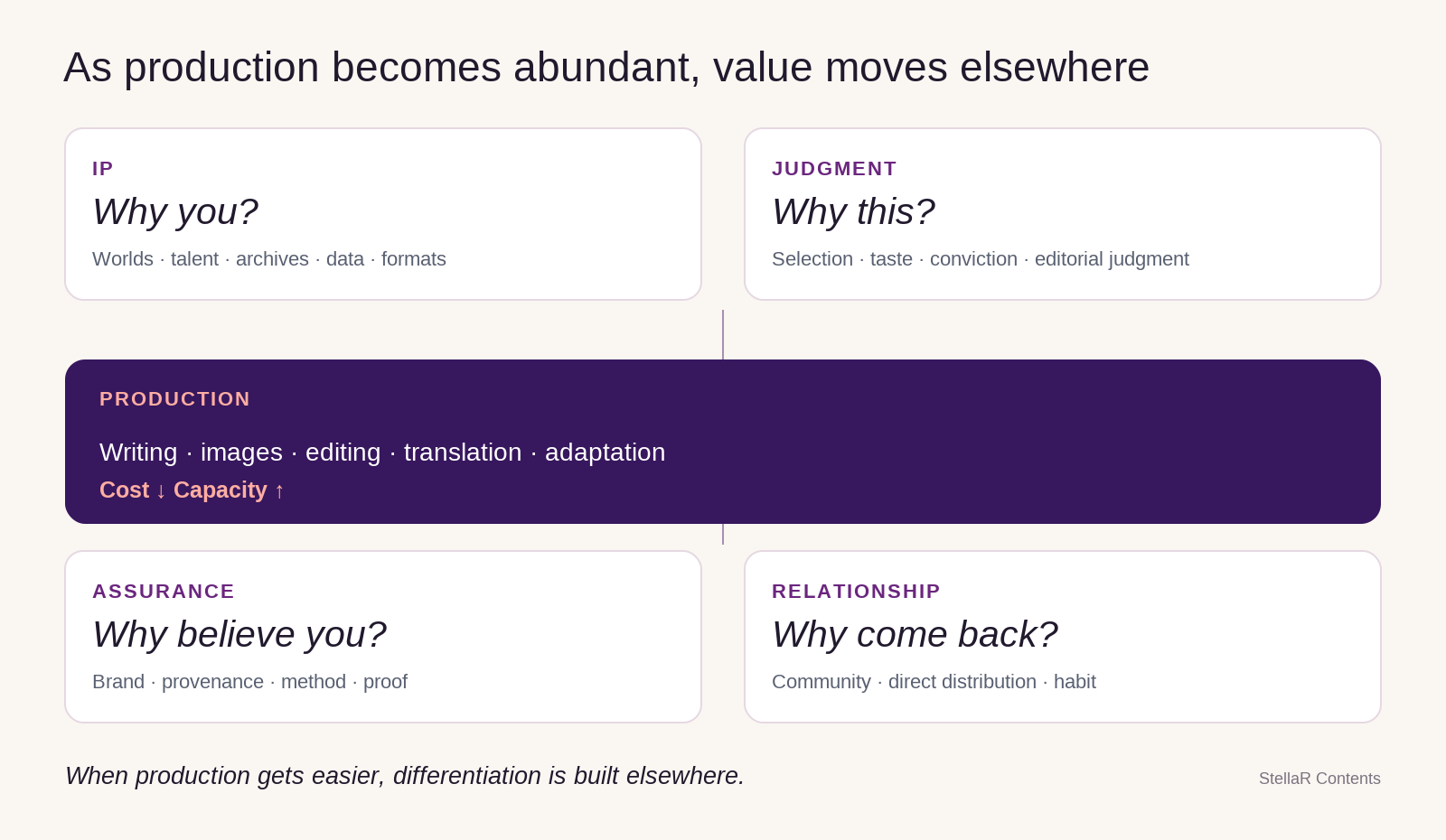
When production becomes abundant, value moves
The answer should not be sought in production alone. If certain capabilities become abundant, value migrates toward complementary resources that remain hard to create. For a media company, brand, platform or creator, four stand out.
IP: why you?
A story, character, archive, proprietary data, franchise, talent, expertise, format, privileged access or community. Here, IP means more than its legal definition. It is what an organization brings to the system that a production tool cannot simply recreate for every competitor.
Two companies can use the same generative model. They do not necessarily have the same raw material. Paradoxically, AI may increase the value of strong IP: translation, localization, adaptation and personalization can extend its return at a lower marginal cost.
When producing becomes cheaper, owning what is worth producing matters more.
That question also underlies Should a brand launch its own YouTube channel or partner with a creator?. Beyond format, the decision is about which asset the company wants to build: a catalog, IP, distribution, trust or a relationship.
Judgment: why this and not something else?
Abundance also increases the value of a less visible skill: choosing.
When an organization could produce ten projects, resource constraints carried out part of the selection. When it can produce a hundred, the question changes. Which deserve to exist? Which have a distinctive idea? Which fit the promise? Which justify staking money, reputation and the audience's attention?
Taste, conviction, selection, editing and the ability to say no are not leftovers from a pre-AI economy. They are mechanisms for creating value. When production becomes easy, deciding what to produce becomes more critical.
Assurance: why believe you?
Abundance also raises the cost of verification. A person cannot check every source and image, establish every origin or assess every claim to expertise before deciding where to spend attention. They use shortcuts: a signature, a brand, a reputation, a primary source, a method, a community or an identifiable accountable party.
This is particularly clear in news. The Reuters Institute found in 2026 that only 20% of respondents said they trusted news from AI chatbots, versus 37% for news overall. Trust was higher among chatbot users themselves, so the figures should not be treated as a uniform rejection of the technology. They do show that a plausible answer and an answer whose provenance feels sufficiently reassuring are not the same thing.
Assurance has an economic function: it lowers the cost of choosing and checking. Audiences need it, but so do advertisers deciding where their money goes, distributors deciding what to recommend and investors deciding what to fund.
The cheaper it becomes to produce something plausible, the more valuable it may be to show where it came from and why it deserves trust.
Relationship: why come back?
Finally, abundance raises the value of an asset that cannot be generated instantly: a relationship already built.
A platform can optimize the likelihood that a piece of content will be chosen. A brand, media company or creator seeks something else: to become a reason to choose the next piece of content. As An audience is not (yet) a meaningful relationship argues, reach is exposure or distribution capacity; a relationship gradually reduces the need to start from zero.
People return because they recognize a promise, then because they trust a signature. Eventually, they may follow it to another format, product or platform. In an economy of abundant content, that continuity matters more.
The real trade-off begins after the productivity gain
This is where the question becomes concrete for executives. Suppose an organization uses AI to save a meaningful amount of production time. It has several options.
The obvious one is to turn that gain into more volume: more articles, videos, adaptations and posts. At team level, the improvement is measurable. At market level, the argument becomes weaker. If everyone reinvests productivity in the same way, they collectively increase supply without increasing available attention. They make it harder to achieve what they wanted: to be chosen.
The other option is to reinvest some of the gain elsewhere: an investigation, talent, an original IP, proprietary data, reporting on the ground, an idea without a benchmark, better verification, a more recognizable brand, a community or a relationship strong enough that the next piece does not start from zero.
The productivity gain becomes more than a way to produce at lower cost. It becomes a way to fund more difference. That may be one of the most consequential AI decisions facing media and creator economy businesses today.
AI does not destroy the value of content. It reveals where that value was.
For a long time, the difficulty of making content accounted for part of its scarcity. That barrier is falling. It does not follow that everything around production becomes abundant too. Attention remains limited. Hits and distinctive IP remain rare. Judgment is scarce. Credible provenance is difficult to establish. A relationship that makes people choose you voluntarily still takes time.
The question AI raises may be less how far can it lower production costs? than which resources become more valuable as those costs fall?
The slop economy shows that extremely low cost can itself be an advantage. The concentration of attention shows that more supply does not necessarily distribute more value. The search for IP shows investors still pay a premium for assets that reduce uncertainty. Early creativity studies suggest better average quality can coexist with more convergence.
These forces can seem contradictory. In fact, they describe the same movement: when production becomes abundant, value migrates to what creates difference, guides decisions about what deserves to exist, reduces uncertainty and builds preference over time.
The final question is therefore not how many more pieces an organization can make with AI. It is more demanding: what will it build with the resources production no longer consumes?